 Admin Admin
Senate passes tobacco-control amendment aimed at regulating emerging nicotine products as health advocates demand stronger safeguards for young Nigerians
ABUJA — Nigeria’s lawmakers have moved closer to reshaping the country’s tobacco-control framework, but the legislation is also reigniting questions about how effectively the country can protect young people from exposure to nicotine products.
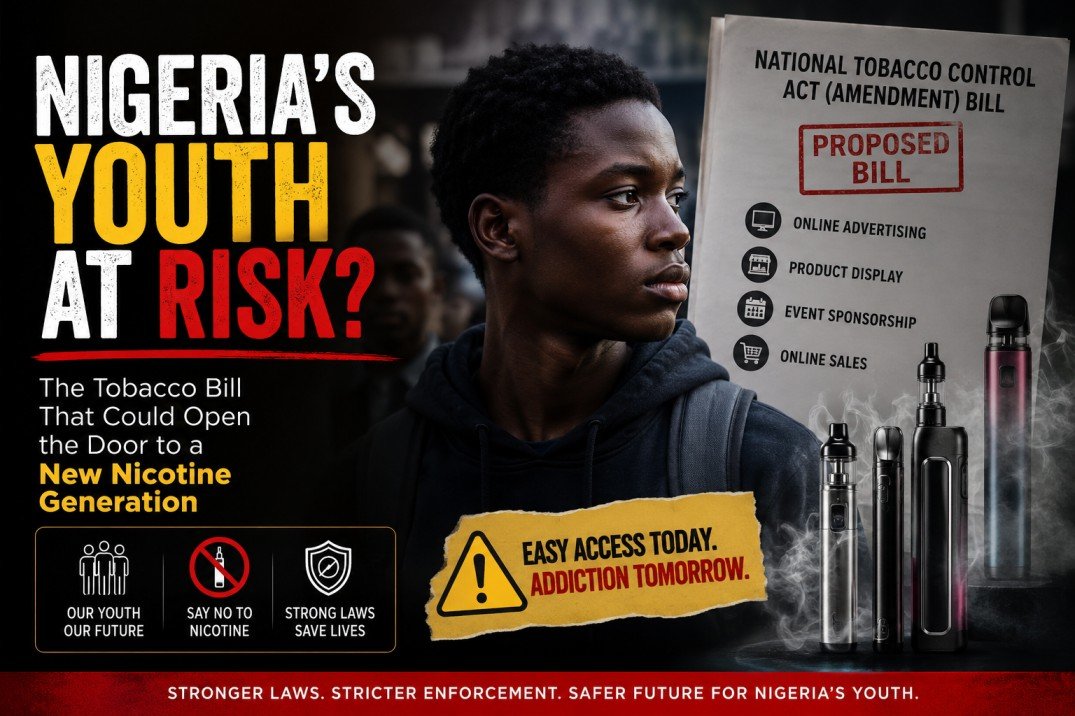
The Senate recently concurred with the National Tobacco Control (Amendment) Bill, 2026, after considering measures transmitted by the House of Representatives. The bill seeks to update Nigeria’s 2015 tobacco-control law and extend regulatory oversight to emerging nicotine products, including non-combustible tobacco products and nicotine pouches.
The legislation has yet to become law. Following Senate concurrence, it is expected to be transmitted to President Bola Tinubu for assent.
The development comes amid growing concern among public-health advocates over the changing nicotine market and the ability of existing regulations to keep pace with products such as electronic cigarettes, vaping devices and nicotine pouches.
A New Generation of Nicotine Products
Nigeria’s existing National Tobacco Control Act, 2015 provides a framework covering areas including smoke-free places, tobacco advertising and promotion, packaging and labelling, product disclosure and other tobacco-control measures.
However, newer nicotine products have created regulatory challenges because some do not fit neatly within rules originally designed around conventional tobacco products.
A recent policy report on Nigeria’s emerging nicotine market argued that e-cigarettes, heated devices and synthetic nicotine pouches have not been adequately covered by the existing framework, creating regulatory gaps.
The proposed amendment is intended, in part, to address that gap.
According to reports on the Senate’s action, the legislation would bring emerging nicotine products under greater regulatory oversight while retaining restrictions on access by minors and use in public places.
Why Youth Protection Is Central
The debate is particularly important in Nigeria because young people are a major part of the country’s population and are heavily exposed to digital media and changing consumer trends.
Public-health advocates have repeatedly warned that tobacco and nicotine companies can exploit gaps in advertising and enforcement rules to reach younger audiences through social media, entertainment and lifestyle marketing.
In May 2026, the Nigeria Tobacco Control Alliance warned that Nigerian adolescents remain vulnerable to nicotine addiction because of weak enforcement of existing tobacco-control laws and changing industry marketing strategies.
The concern is not limited to traditional cigarettes.
As nicotine products become increasingly diverse, advocates say regulation must ensure that new products do not become a pathway for young people to begin using nicotine.
The Advertising and Access Question
One of the biggest challenges facing policymakers is how to regulate nicotine products in an environment where advertising and commercial activity increasingly occur online.
Social-media content can cross age boundaries quickly, while online marketplaces and delivery services can make monitoring difficult.
Health advocates have therefore called for stronger enforcement of existing tobacco-control measures and comprehensive restrictions on tobacco advertising, promotion and sponsorship.
CAPPA, a Nigerian public-health advocacy organisation, has also warned that regulatory gaps surrounding emerging nicotine products could leave young people vulnerable to exposure. In March 2026, the organisation called for increased government funding for tobacco control, saying Nigeria’s existing enforcement resources were inadequate.
A Bill Designed to Close Regulatory Gaps
The current legislative push is not simply about loosening tobacco rules.
The House version of the bill contains provisions specifically aimed at regulating non-combustible products and electronic nicotine or non-nicotine delivery systems. Parliamentary records show that the proposed framework includes product-notification requirements for manufacturers and importers and additional controls for these products.
The House also approved the bill after considering recommendations from its Committee on Healthcare Services. Several clauses were approved while others were rejected during consideration.
The Senate subsequently concurred with the legislation without amendment.
This means the central question now shifts from whether Nigeria should regulate emerging nicotine products to how effectively those regulations will protect the public—particularly young people—if the bill becomes law.
Health Advocates Want Stronger Enforcement
Public-health advocates say legislation alone will not solve Nigeria’s tobacco problem.
They point to funding and enforcement as major weaknesses.
In July, health advocates urged the Federal Government to increase annual tobacco-control funding from about N13 million to at least N300 million, arguing that inadequate resources could undermine enforcement, public education, research, cessation services and monitoring of the tobacco industry.
The funding debate is significant because a law can only be as effective as the institutions responsible for enforcing it.
Without sufficient resources, monitoring online advertising, retail outlets, imports, product registration and compliance could remain difficult.
The Bigger Question: Protection or Prevention?
The proposed amendment presents Nigeria with an important policy choice.
On one hand, lawmakers have recognised that the country’s tobacco-control framework needs to address products that were not adequately covered when the 2015 law was enacted.
On the other, health advocates argue that regulation must not merely acknowledge new nicotine products—it must ensure that young Nigerians are protected from aggressive marketing, easy access and early exposure.
The distinction matters.
A modern tobacco-control law should not simply respond to what is already in the market. It should also anticipate how the market could evolve.
What Happens Next?
The Senate’s passage of the amendment means the legislative process has reached a critical stage.
The bill is expected to move to the President for assent before it can become law.
Until that happens, the existing legal framework remains in force.
For lawmakers, health authorities, parents and civil society organisations, the next stage will be closely watched.
The debate is ultimately bigger than cigarettes or vaping devices.
It is about whether Nigeria can build a regulatory system that keeps pace with a rapidly changing nicotine market without allowing young people to become its easiest target.


 Admin Admin